
Is your dog just slower, or is something structural actually changing? That’s the question behind most “is this normal aging” messages I get, and with collagen, the honest answer is both: something structural really is changing, and it starts earlier than most owners assume.
Collagen is the most abundant protein in a dog’s body. It’s the scaffolding in cartilage, tendons, ligaments, and skin — the material that lets a joint absorb load and a hip glide instead of grind. Fibroblasts and chondrocytes (the cells that build and maintain that scaffolding) don’t stop working as a dog ages, but they slow down, and the collagen they do produce turns over less efficiently and holds less water. That’s the mechanism behind a lot of what owners describe as “getting old”: duller coat, thinner skin that bruises or tears more easily, and joints that feel tighter first thing in the morning.
Cartilage itself is mostly water held in place by a collagen fibril network, and in osteoarthritic joints that network degrades — matrix fibrillation, fissuring, eventually full-thickness loss of the cartilage surface, as described in cartilage-related collagen research on PMC (NIH): osteoarthritis pathology. Advanced age is a recognized risk factor for that process, though it’s worth being precise here: osteoarthritis is common in older dogs, not an inevitable part of aging itself. A healthy 10-year-old and an arthritic 10-year-old can have very different collagen stories.
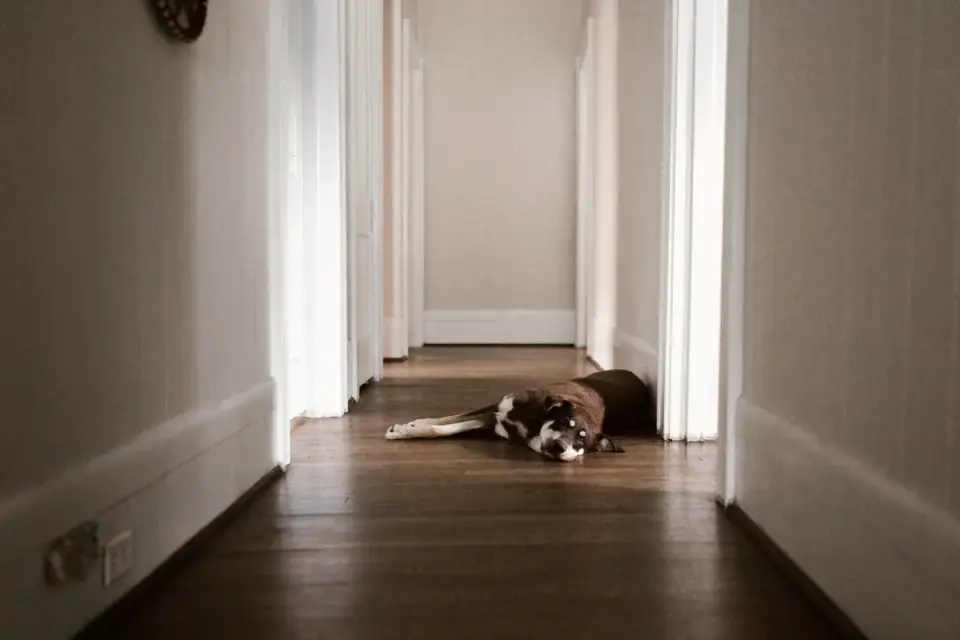
A 6-year-old Labrador I hear about often in messages is a useful composite case: mid-size, active, no prior joint issues, and the owner’s only complaint is that she’s slower on the stairs by the third week of colder weather each fall. That’s not a diagnosis — it’s a pattern. The dog isn’t limping, isn’t reluctant to jump, and eats and moves normally once warmed up. That combination usually means normal age-related stiffness, not disease, but it’s exactly the kind of case where I tell owners to start tracking, not guessing.
Here’s where I push back on a common assumption: that if collagen decline is happening, more collagen in the bowl automatically fixes it. It’s more complicated. A narrative review of collagen hydrolysates in canine osteoarthritis found that these peptides are absorbed largely as amino acids and short di- and tripeptides that reach joint tissue, and in vitro work showed increased collagen type II synthesis in chondrocytes along with reduced catabolic effects from the inflammatory cytokine IL-1β — but the same Journal of Animal Physiology and Animal Nutrition review noted that biomarker results across studies were inconclusive, and one randomized trial showed improved limb load-bearing on force plate testing after 12 weeks without owners actually reporting less pain. That gap between measurable and felt improvement is exactly why I don’t oversell this category to owners.
I also want to flag a failure mode I see a lot: an owner tries a joint supplement for two weeks, sees nothing, and quits — right before any realistic window for cartilage-level change has passed. A 62-pound senior mixed-breed I discussed with one owner had been on a collagen-containing joint chew for 18 days when she asked if it was “even doing anything.” It wasn’t a fair question yet. The force-plate improvements in the dog studies above showed up at 12 weeks, not two. That mismatch between owner expectations and biological timelines is where a lot of supplement decisions go wrong — not because the ingredient failed, but because nobody set the right clock.
The three-step check I actually walk owners through when they ask about collagen decline:
- Watch the pattern, not the moment. One stiff morning after a long hike means nothing. Stiffness that’s consistent for two or more weeks, or that doesn’t loosen with movement, is worth flagging.
- Separate skin signs from joint signs. Thinning, slower-healing skin and a duller coat point toward general collagen turnover slowing with age. Reluctance to jump, favoring a limb, or a change in gait points toward joint-specific changes and deserves an exam, not a supplement trial.
- Give any intervention 8–12 weeks before judging it. Collagen remodeling in cartilage is slow. If you switch food, add a joint supplement, or change exercise, track weight-bearing and stair behavior weekly and compare at 12 weeks, not day 10.
There’s an edge case worth naming, because it changes how this applies in practice: not every “stiff senior dog” story is about collagen at all. A 12-year-old small-breed dog whose owner described sudden reluctance to walk turned out, on exam, to have a luxating patella that had nothing to do with age-related collagen decline — it needed orthopedic evaluation, not a joint chew. Age-related collagen slowdown is real and gradual; a sudden, acute change in gait is a different problem and belongs in front of a vet, not a supplement aisle.
Collagen metabolism itself also shifts with age at the tissue level — research on canine osteoarthritis found altered collagen metabolism in affected joints, including increased type VI collagen deposition around chondrocytes in osteoarthritic cartilage relative to healthy joints, a pattern documented in PubMed (NIH): increased metabolism of collagen VI in canine osteoarthritis. That’s a sign the joint is actively remodeling in response to damage, not just quietly aging.
If your dog’s stiffness comes and goes with weather and activity, that’s usually normal collagen-related aging you can manage with monitoring and time. If it’s constant, worsening, or paired with limping, swelling, or reluctance to bear weight, that’s a vet visit — not a wait-and-see supplement trial. If you’re also managing recurrent skin or paw issues alongside joint stiffness, it’s worth reading how we approach multimodal allergy plans, since skin and coat changes sometimes get lumped in with “aging” when they have a separate, treatable cause.
Quick recap: collagen production doesn’t stop as dogs age, it slows and turns over less efficiently, which shows up first in skin and coat and later in joint cartilage. Supplementation has real mechanistic support but an inconsistent clinical track record, and any trial needs 8–12 weeks before you judge it. Track the pattern, separate skin signs from joint signs, and get an acute or worsening gait change checked rather than assumed.
Frequently asked questions
At what age does collagen decline start in dogs?
There's no single verified age cutoff across all dogs — it depends heavily on breed and size, with larger breeds generally showing joint-related effects earlier than small breeds. What matters more than a number is whether you're seeing a consistent pattern of stiffness or skin changes, not a single data point.
Should I start a collagen supplement before my dog shows any signs?
I don't recommend starting supplements preemptively without a specific reason — talk to your vet about your dog's individual risk factors first. If you do start one, commit to at least 8–12 weeks before judging whether it's working.
Is stiffness in an older dog always osteoarthritis?
No. Normal age-related stiffness that loosens with movement and doesn't worsen is different from osteoarthritis or an acute orthopedic issue. A sudden change in gait, persistent limping, or reluctance to bear weight needs a veterinary exam, not a guess.
Sources
- Cartilage-Related Collagens in Osteoarthritis and Rheumatoid Arthritis — PMC (NIH)
- Collagen Hydrolysates as Nutritional Support in Canine Osteoarthritis: A Narrative Review — Journal of Animal Physiology and Animal Nutrition
- Increased metabolism of collagen VI in canine osteoarthritis — PubMed (NIH)