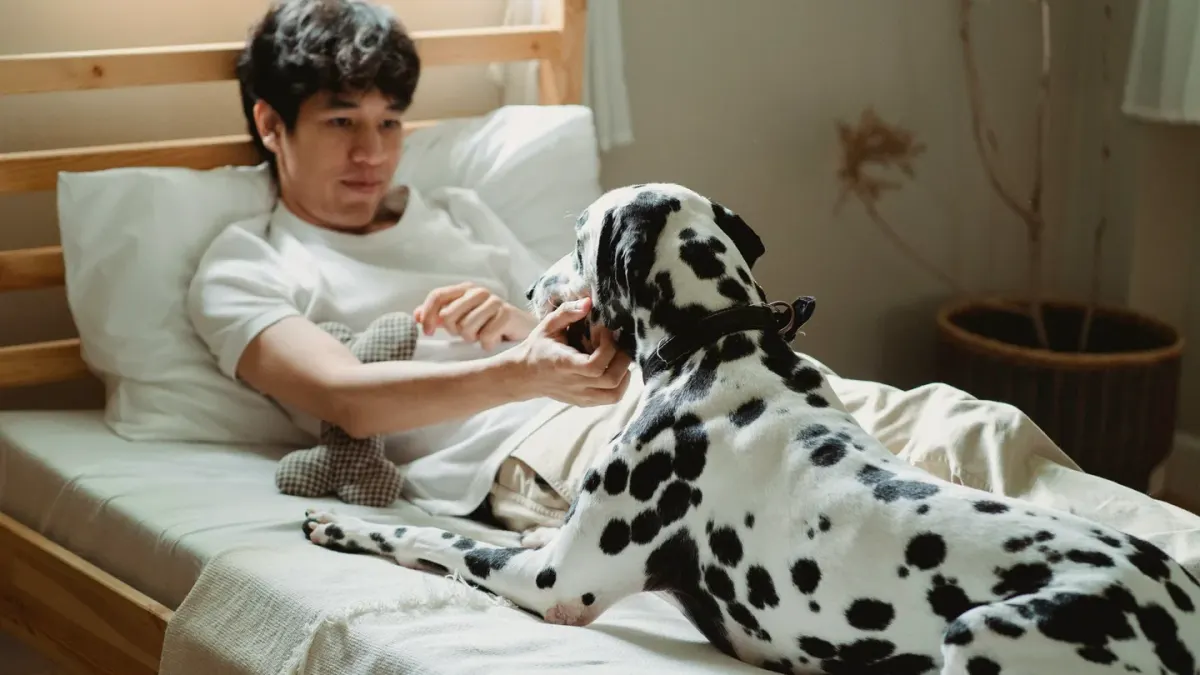
Here’s the premise I want to push back on first: that a senior dog going quiet on toys is just what happens with age, and there’s nothing to check.
I don’t buy that as a starting assumption. It’s sometimes true. But “he’s just getting old” is the explanation owners reach for because it’s the least scary one, and in my exam room it’s wrong often enough that I never accept it as a first answer. Before you write this off as normal aging, run this:
- Check the body first. Watch him get up from the floor, take stairs, and jump onto furniture. Stiffness, slow rises, or refusal to jump points toward joint pain, not disinterest.
- Check the sensory story. Does he still orient to a dropped treat or a squeaky sound from across the room? Vision and hearing loss make toys less rewarding long before an owner notices the dog is missing cues.
- Check the whole-dog picture. Is he also sleeping oddly, pacing at night, seeming lost in familiar rooms, or less interested in greeting you? That cluster points toward cognitive change, not toy boredom.
I want to walk through why each of those matters, because they lead to very different next steps.
In my practice, the case that sticks with me is a 10-year-old Labrador named Cooper, 78 pounds, whose owner brought him in because he’d stopped chasing his tennis ball in the backyard. She’d noticed it over about six weeks — first he’d chase it twice instead of ten times, then he’d just watch it roll past on the patio and go lie in the shade instead. She assumed he was slowing down for good, the way older dogs do. On exam, Cooper had reduced range of motion in both hips and a subtle hitch in his gait after resting, worse in the evening. He wasn’t bored of the ball. Getting to it and pivoting on it hurt. Once we addressed the joint pain, the ball-chasing came back within a couple of weeks, not because his personality changed but because the discomfort that had been masquerading as disinterest was gone.
That’s the pattern I see most: owners read “less playful” as a personality shift when it’s actually a mobility or pain problem wearing a behavioral costume. Osteoarthritis is extremely common in older dogs, and researchers examining activity patterns in dogs with hip and knee osteoarthritis found that pain, higher age, and muscle atrophy were all tied to reduced activity levels, exactly the kind of quiet activity decline that shows up first as “he doesn’t play anymore” (as documented in a PMC-indexed study). If your dog still brightens up for a walk or a car ride but skips the toy basket specifically, pain that flares with quick, twisting movement — the kind toy play demands — is my top suspect.
Cognitive change is the other big one, and it’s easy to miss because it doesn’t look dramatic. Dogs with cognitive dysfunction don’t usually refuse a toy on purpose; they lose the thread of what the toy is for, or they get anxious in ways that make play feel unsafe rather than fun. The AAHA senior care guidelines use a screening framework — disorientation, altered social interactions, altered sleep-wake cycles, house soiling, and altered activity levels — to flag this early, because the earliest signs are often just as subtle as “less interested in greeting you or playing” (per AAHA). If toy avoidance shows up alongside nighttime pacing, staring at walls, or forgetting a routine he’s done for years, that’s the pattern I want ruled in or out, not guessed at.
Where the evidence gets thinner is around cellular aging supplements marketed for exactly this kind of “senior dog seems less like himself” complaint. Quercetin has been studied for antioxidant and immune-related cellular support, but the caution I’d flag to owners is that dose and species matter enormously — in one lab study, quercetin formulations “did not affect the feeding behavior of the worms” at the concentrations tested, which is a reminder that in-vitro findings don’t automatically translate to a dog eating a chew on your kitchen floor (per Pharmaceuticals (MDPI)). Resveratrol research shows a similar need for caution about dose: one study found that embryonic exposure to a specific resveratrol concentration “accelerated pupation and adult emergence but shortened adult lifespan” in the model organism tested (per Phytomedicine). That’s not a reason to dismiss these ingredients — it’s a reason to want dosed, dog-specific data before you build your expectations around them, and to treat any supplement as a support alongside diagnosis, never a replacement for it.
I’ve watched this play out enough times to have a rule for myself: never let a supplement conversation happen before a mobility and cognitive check. One of the dogs I worked with, a 12-year-old spayed female terrier mix named Biscuit, came in because her owner had already tried three different “senior vitality” chews over four months with no change in her toy interest. Biscuit weighed 22 pounds and had gone from carrying her stuffed hedgehog around the house daily to ignoring it entirely. The owner’s instinct — try a supplement first, see the vet if that doesn’t work — is common, and it’s backwards. Biscuit turned out to have moderate dental disease with a likely painful fractured tooth, discovered only once we did a full oral exam under sedation for bloodwork. She wasn’t losing interest in toys because she was aging out of play. Chewing hurt. No chew or capsule was ever going to fix that.
That’s why I push owners toward the exam room before the supplement aisle, not after. If you decide to look into supplements once a medical cause has been ruled out or addressed, know what you’re actually buying: nicotinamide riboside is a NAD+ precursor studied for supporting normal cellular function at a dose of 120 mg per 2-chew serving, and quercetin is a flavonoid with antioxidant properties studied for immune and cellular support at 100 mg per 2-chew serving, per a vet-reviewed claims list (reviewed by Dr. Sarah Mitchell, DVM). Resveratrol at 40 mg paired with quercetin at 100 mg per serving is described in the same fact bank as supporting cellular health and vitality. I’d treat those as supportive claims, not fixes for pain or cognitive decline — they’re not a substitute for the exam that finds the actual cause.
Where I land: don’t skip straight to “he’s just old.” Run the three-step check — body, senses, whole-dog pattern — before you accept that explanation. If the change is sudden (days to a couple of weeks) rather than gradual, if he’s also limping, drinking more, losing weight, or seems disoriented in his own house, call your veterinarian rather than waiting it out. Persistent joint pain and cognitive changes are both manageable when caught early, and neither one gets better by ignoring the toy basket. If your dog is also dealing with recurring paw licking or itching alongside the behavior change, that’s worth a separate look too — see our guide on why recurrent paw licking and itching need a multimodal allergy plan for that piece of the picture.
So the honest answer to “why did my senior dog stop caring about his toys” is: it depends, and the way to find out isn’t guessing, it’s checking his joints, his senses, and his overall pattern in that order. Which of those three is showing up in your dog right now?
Frequently asked questions
My senior dog still walks fine but ignores his toys — could it still be pain?
Yes. Toy play often demands quicker, twisting movement than a normal walk, so a dog with early joint pain can look completely normal on a leash walk and still avoid the fast pivots a toy chase requires.
How fast should I worry if my dog suddenly stops playing?
A gradual decline over months is more consistent with slow joint or cognitive change; a sudden drop over days points more toward acute pain, illness, or dental problems and deserves a same-week veterinary visit.
Are longevity supplements a reasonable first step before a vet visit?
No. Rule out pain, dental disease, and cognitive change first. Supplements like nicotinamide riboside, quercetin, and resveratrol are studied for cellular support, not for diagnosing or treating the underlying cause of lost play interest.
Sources
- First ever guidelines published for diagnosis and monitoring of canine cognitive dysfunction — AAHA
- Factors influencing, and associated with, physical activity patterns in dogs with osteoarthritis-associated pain — PMC
- Quercetin feeding behavior study — Pharmaceuticals (MDPI)
- Resveratrol embryonic exposure study — Phytomedicine